


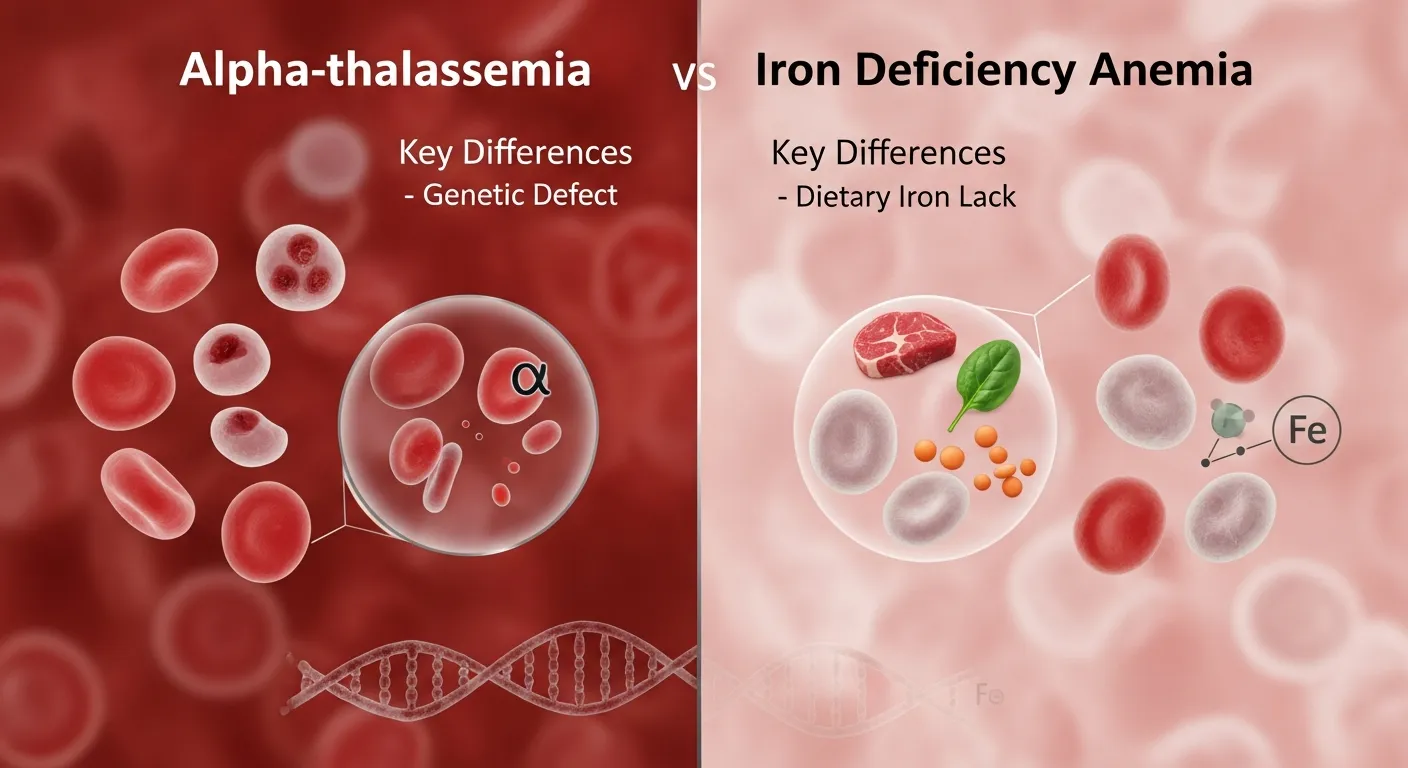
Understanding alpha trait vs iron deficiency anemia is important for accurate diagnosis and treatment. While both conditions can cause small red blood cells and mild anemia, blood tests, iron studies, and genetic evaluation help identify the underlying cause and guide proper care.
Alpha trait vs iron deficiency anemia both cause small red blood cells, but ferritin tells them apart—it’s low in iron deficiency and normal in alpha thalassemia trait. Genetic testing confirms the trait.
Two people can have nearly identical blood test results yet need completely different care. That’s the puzzle at the heart of the alpha trait vs iron deficiency debate. Both conditions produce small, pale red blood cells (microcytic, hypochromic anemia), and both can leave you feeling tired or looking pale. Yet one is a harmless inherited trait, while the other is a treatable deficiency that often signals an underlying problem.
Getting this distinction right matters more than most people realize. When alpha thalassemia trait is mistaken for iron deficiency, patients may be prescribed iron supplements they don’t need—and unnecessary iron can build up and cause harm. On the flip side, missing a true iron deficiency means the real cause, sometimes serious blood loss, goes untreated.
This guide breaks down the alpha trait vs iron deficiency question in plain language. You’ll learn what each condition is, how doctors diagnose them, which lab markers separate them, and why an accurate alpha thalassemia trait diagnosis protects both your health and your treatment plan. By the end, you’ll understand exactly how these two look-alike conditions differ—and what to ask your doctor next.
Alpha Trait vs Iron Deficiency Anemia: What Is Alpha Thalassemia Trait?
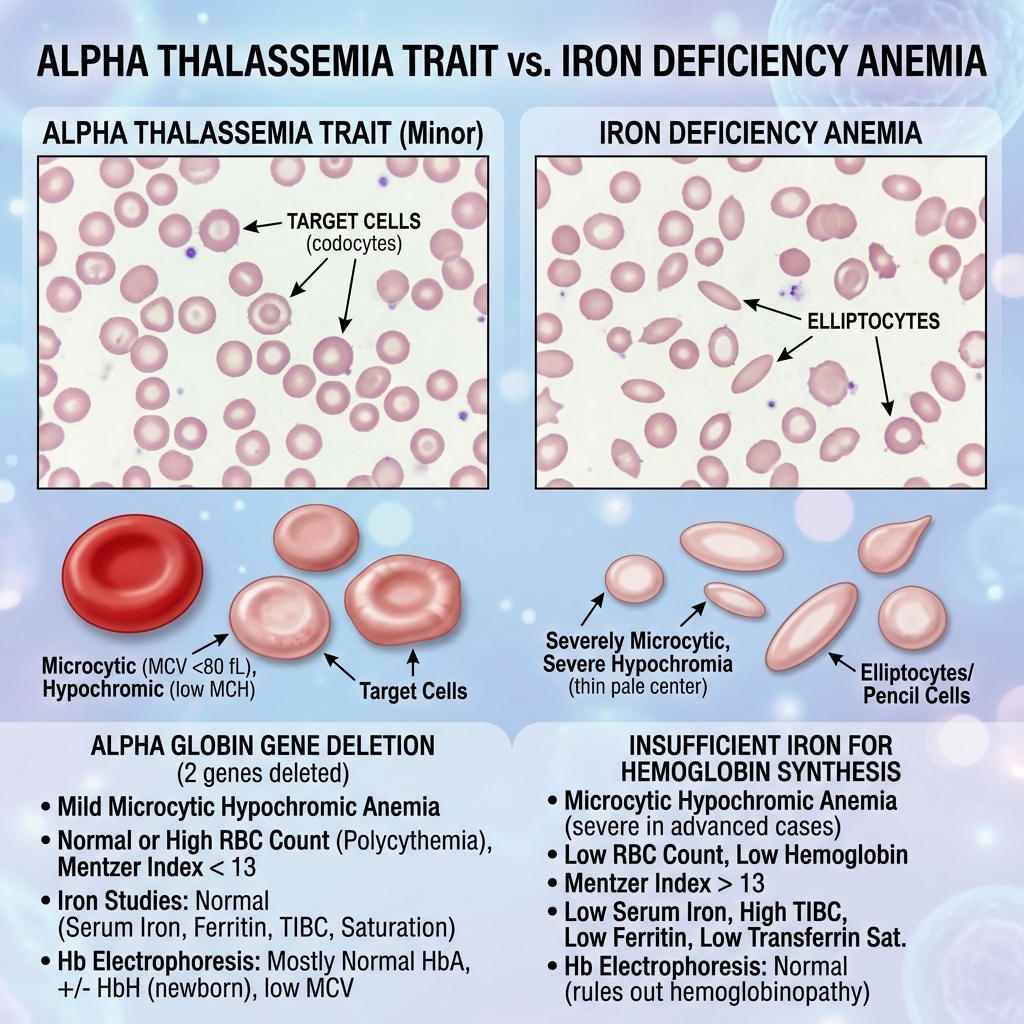 Alpha thalassemia trait, also called alpha thalassemia minor, is an inherited blood condition caused by the loss of two of the four alpha-globin genes. These genes control how your body makes alpha-globin, a building block of hemoglobin—the protein in red blood cells that carries oxygen throughout your body.
When two of these genes are missing, the two remaining genes still produce hemoglobin, just slightly less than normal. The result is mild microcytosis (smaller red blood cells) and sometimes very mild anemia. For most carriers, this causes no noticeable health effects at all.
How genetics cause the alpha thalassemia trait
Four alpha-globin genes sit on chromosome 16—two inherited from each parent. These genes, known as HBA1 and HBA2, work together to produce alpha-globin chains. When two of the four genes are deleted or mutated, the alpha thalassemia trait appears.
The two missing genes can be arranged in two ways: both on the same chromosome (–/αα) or one on each chromosome (-α/-α). This distinction matters for inheritance risk, especially for couples planning a family. For a closer look at the milder end of the spectrum, this guide on the silent carrier alpha thalassemia explains how a single missing gene behaves.
Symptoms of alpha thalassemia trait
Most carriers of the alpha thalassemia trait have no symptoms at all. The body compensates well enough that daily life is completely unaffected.
When signs do appear, they trace back to mild anemia and may include:
- Mild, ongoing fatigue
- Slight paleness of the skin
- Shortness of breath during physical activity
- Occasional dizziness
These signs are usually so subtle that they go unnoticed or get blamed on a busy schedule. Importantly, the alpha thalassemia trait does not progress to a severe form over time—your genetic makeup stays the same throughout life.
What is iron deficiency anemia?
Iron deficiency anemia develops when your body doesn’t have enough iron to produce adequate hemoglobin. Since iron sits at the core of every hemoglobin molecule, low iron directly limits how much hemoglobin your red blood cells can make. The cells turn out smaller and paler, and oxygen delivery drops.
Iron deficiency is the most common nutritional deficiency worldwide, and unlike the alpha thalassemia trait, it has identifiable causes that can often be corrected.
Common causes of iron deficiency anemia
Iron deficiency anemia typically stems from one of three sources:
- Inadequate dietary intake: Not eating enough iron-rich foods, common in vegetarian or restrictive diets.
- Poor absorption: Conditions like celiac disease or certain surgeries can impair how the gut absorbs iron.
- Blood loss: Heavy menstrual periods, gastrointestinal bleeding, or frequent blood donation can deplete iron stores over time.
Identifying the underlying cause is just as important as treating the deficiency itself. In some cases, chronic blood loss points to a problem that needs medical attention.
Symptoms of iron deficiency anemia
Iron deficiency anemia symptoms tend to be more pronounced than those of the alpha thalassemia trait, especially as iron stores drop.
Common signs include:
- Persistent fatigue and weakness
- Pale skin
- Shortness of breath
- Dizziness or lightheadedness
- Cold hands and feet
- Brittle nails
- Pica (cravings for non-food items like ice or dirt)
Pica, in particular, is a distinctive clue that points toward iron deficiency rather than a thalassemia trait.
The crucial distinction: alpha trait vs iron deficiency
 Here’s where the confusion begins. The alpha trait vs iron deficiency comparison trips up patients and clinicians alike because both conditions share a striking surface-level similarity.
Why are these two conditions confused
Both alpha thalassemia trait and iron deficiency anemia produce microcytic, hypochromic anemia—red blood cells that are smaller and paler than normal. On a basic blood test, the mean corpuscular volume (MCV) and mean corpuscular hemoglobin (MCH) often look similar in both conditions. Add in overlapping symptoms like fatigue and pallor, and it’s easy to see why one gets mistaken for the other.
According to the Centers for Disease Control and Prevention, proper testing prevents thalassemia carriers from being wrongly treated for iron deficiency. This single distinction shapes whether you receive the right care.
Key differentiating lab markers
The lab work tells the real story. While a complete blood count (CBC) raises the initial question, a few specific markers separate alpha trait from iron deficiency:
- Serum ferritin: This is the single most useful marker. Ferritin is low in iron deficiency anemia and normal in the alpha thalassemia trait. It reflects how much iron your body has stored.
- Total iron-binding capacity (TIBC): TIBC is typically high in iron deficiency (the body is “hungry” for iron) and normal in the alpha thalassemia trait.
- Transferrin saturation: This is low in iron deficiency and normal in the trait.
- Red cell distribution width (RDW): RDW is often elevated in iron deficiency because cell sizes vary widely, while it tends to be normal in the alpha thalassemia trait, where cells are uniformly small.
- Red blood cell (RBC) count: Often normal or even slightly high in the alpha thalassemia trait, but typically low in iron deficiency anemia.
- Hemoglobin electrophoresis: This is often normal in the alpha thalassemia trait but helps rule out other hemoglobin disorders.
A side-by-side comparison
|
Marker |
Alpha Thalassemia Trait |
Iron Deficiency Anemia |
|---|---|---|
|
MCV (cell size) |
Low |
Low |
|
MCH |
Low |
Low |
|
Serum ferritin |
Normal |
Low |
|
TIBC |
Normal |
High |
|
Transferrin saturation |
Normal |
Low |
|
RDW |
Normal |
Often elevated |
|
RBC count |
Normal or high |
Low |
|
Cause |
Genetic (inherited) |
Diet, absorption, or blood loss |
The standout takeaway: check ferritin first. A low MCV paired with normal ferritin strongly suggests a thalassemia trait, while a low MCV with low ferritin points to iron deficiency. For a deeper walkthrough of these values, this thalassemia blood test guide breaks down each number.
How is each condition diagnosed?
A clear diagnosis follows a logical sequence, and knowing the steps helps you understand what your doctor is looking for.
Diagnosing the alpha thalassemia trait
Diagnosis usually begins with a CBC that shows a low MCV. When iron studies come back normal—especially normal ferritin—doctors suspect a thalassemia trait. Hemoglobin electrophoresis often appears normal in the alpha thalassemia trait, so genetic (DNA) testing is the definitive method. It maps the alpha-globin genes and confirms exactly how many are missing. For the full diagnostic pathway, see this guide on thalassemia diagnosis methods.
Diagnosing iron deficiency anemia
Iron deficiency anemia diagnosis relies on iron studies: low ferritin, high TIBC, and low transferrin saturation confirm the deficiency. Once confirmed, the next critical step is finding the underlying cause. A doctor may investigate dietary habits, screen for absorption issues, or look for sources of blood loss. Treating the iron deficiency without addressing its cause only solves half the problem.
Why an accurate diagnosis matters for treatment
The treatment paths for these two conditions could not be more different—and that’s exactly why getting the diagnosis right is so important.
For iron deficiency anemia, the fix is usually straightforward: iron supplementation, dietary changes, and addressing the root cause. Most people respond well once their iron stores are replenished.
For the alpha thalassemia trait, no treatment is needed. Carriers should not take iron supplements unless a doctor confirms a genuine, separate deficiency. Because the small red blood cells of the trait can be mistaken for iron deficiency, some carriers are wrongly prescribed iron. Unnecessary iron can accumulate in the body and cause harm over time. This is why telling your doctor about a known carrier status—or asking for ferritin testing before starting iron—is so valuable.
Choose genetic testing if your CBC shows small red blood cells, but your ferritin is normal, as this combination points away from iron deficiency and toward a thalassemia trait. To understand the broader condition, this guide on thalassemia awareness offers a complete overview.
Can you have both alpha thalassemia trait and iron deficiency?
Yes—and this is where things get tricky. A person can carry the alpha thalassemia trait and develop iron deficiency at the same time. When both occur together, ferritin may drop while the genetic trait persists, muddying the lab picture.
In these cases, doctors often treat the iron deficiency first, then reassess. If small red blood cells remain after iron stores are restored, an underlying thalassemia trait becomes the likely explanation. According to research summarized by the World Health Organization, thalassemia is a major global public health concern, and overlapping conditions like this make careful, layered testing essential.
What to do next if your blood test is confusing
 If a routine blood test shows small red blood cells (low MCV), don’t panic—and don’t reach for iron supplements on your own.
Take these practical steps:
- Ask for iron studies, especially serum ferritin, to check your actual iron stores.
- Share your family history and ancestry. Alpha thalassemia is more common in people of Southeast Asian, African, Mediterranean, and Middle Eastern descent.
- Request genetic testing if your ferritin is normal, but your red blood cells stay small.
- Consider genetic counseling if you’re planning a family, since two carriers can pass a more serious form to their children.
These steps turn a confusing result into a clear, actionable plan.
Knowing the difference protects your health
The alpha trait vs iron deficiency question comes down to one core idea: similar-looking blood doesn’t mean similar conditions. Both produce small, pale red blood cells, but the alpha thalassemia trait is a harmless inherited state with normal iron levels, while iron deficiency anemia is a treatable shortage with low ferritin and an identifiable cause.
The smartest move is simple—check ferritin before assuming iron deficiency, and request genetic testing when the numbers don’t add up. Getting an accurate alpha thalassemia trait diagnosis prevents unnecessary iron supplementation, ensures real deficiencies get treated, and supports informed family planning.
If your recent blood work left you with questions, talk to your doctor about the right next test. To explore the topic further, read more about alpha thalassemia trait symptoms and how this condition compares across the spectrum.
Frequently Asked Questions (FAQs)
1. What is the main difference between alpha trait and iron deficiency?
The main difference in the alpha trait vs iron deficiency comparison is the cause and the iron level. The alpha thalassemia trait is a genetic condition with normal ferritin, while iron deficiency anemia results from low iron and shows low ferritin. Both cause small red blood cells.
2. Can a blood test tell the difference between alpha trait and iron deficiency?
Yes. A CBC shows small red blood cells in both conditions, but iron studies separate them. Normal ferritin points to the alpha thalassemia trait, while low ferritin confirms iron deficiency anemia. Genetic testing provides the definitive answer for the trait.
3. Why is ferritin so important in telling them apart?
Ferritin reflects your body’s stored iron. It is normal in the alpha thalassemia trait and low in iron deficiency anemia. Because it’s the clearest dividing line between the two conditions, doctors often check ferritin first.
4. Should I take iron supplements if I have the alpha thalassemia trait?
No, not unless a doctor confirms a genuine iron deficiency. Carriers have normal iron levels despite having small red blood cells. Taking unnecessary iron can build up and cause harm, so always confirm your status with iron studies first.
5. Can you have both alpha thalassemia trait and iron deficiency anemia?
Yes. A person can carry the alpha thalassemia trait and develop iron deficiency at the same time. Doctors usually treat the iron deficiency first, then reassess. If small red blood cells remain after iron is restored, the trait is the likely cause.
6. How is alpha thalassemia trait diagnosed?
Alpha thalassemia trait diagnosis starts with a CBC showing low MCV and normal iron studies. Hemoglobin electrophoresis is often normal, so genetic (DNA) testing is the definitive method to confirm how many alpha-globin genes are missing.
7. What lab markers are different in alpha trait vs iron deficiency?
Ferritin, TIBC, transferrin saturation, RDW, and RBC count differ. In iron deficiency, ferritin is low, TIBC is high, and RDW is often elevated. In the alpha thalassemia trait, ferritin and TIBC are normal, RDW is usually normal, and RBC count may be normal or high.
8. Does the alpha thalassemia trait cause severe symptoms?
No. Most people with the alpha thalassemia trait have no symptoms. When present, signs are mild—slight fatigue, paleness, or breathlessness during exercise. The trait does not progress to a severe form over time.
9. Is iron deficiency anemia more serious than alpha thalassemia trait?
They are different rather than ranked. Iron deficiency anemia is treatable but may signal an underlying issue like blood loss that needs attention. The alpha thalassemia trait is harmless on its own but matters for family planning, since two carriers can pass a serious form to children.
10. When should I see a doctor about confusing blood test results?
See a doctor if a blood test shows small red blood cells (low MCV), especially if you feel persistently tired. Ask for iron studies and, if your ferritin is normal, request genetic testing. Early clarity prevents unnecessary treatment and supports informed decisions.
